Cliff # 1

About cliffeconomics

This blog offers original economic thought and policy recommendations on Germany, the euro area, and whatever cliff has on his mind.

Cliff # 3

About cliff

The author is an economist specialized in financial and macroeconomic policy analysis. All posts present a personal opinion, and all analysis is based on publicly available information.

Cliff # 1

About cliff

The author is an economist specialized in financial and macroeconomic policy analysis. All posts present a personal opinion, and all analysis is based on publicly available information.

Showing posts with label transfer. Show all posts

Friday, June 15, 2012

Why Germany wants to keep Greece in the euro area


Germany had a good crisis---this is how the commentator Satyajit Das, Roubini's fellow blogger and author of "Traders, Guns, and Money"---nicely puts it. Since the subprime crisis spilled over the Atlantic, Germany's output took a leap forward above pre-crisis levels, unemployment plummeted, the budget deficit vanished, and household net wealth grew to about EUR225,000 per household. Today, ECB's monetary policy gives an additional stimulus with interest rates at 1 percent whereas the Taylor rule suggests 4.5 percent would be more appropriate (compared to 2009 when ECB first dropped rates to that level). Recently, the euro started depreciating, giving German exports some extra boost. The crisis works phenomenally for Germany! Why stopping it?

But the current sentiment is overshadowed by tendencies of disintegration. The economic Diktat has stoked popular resentment in the crisis countries, toppling the political leadership and sometimes leaving the necessary political reforms in limbo. This is pretty bad. Unless there are second thoughts on both sides, the alternative is the disintegration of the euro area. While Greece may be the first and obvious candidate to exit, it is hard to imagine how to contain further disintegration. Preventing contagion that will trigger the exit of others (described here) will only be contained through large and unconditional commitments from Germany. These commitments may dwarf the cost of keeping Greece in the euro area in the first place. Let's run some numbers. Below table composes direct breakup costs, losses from German investments in the crisis countries, and the drag on annual export demand. 
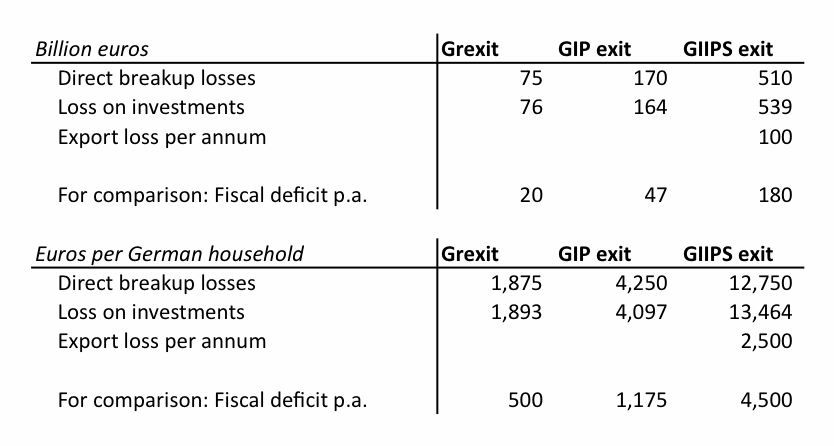

The direct breakup losses to Germany from the default of exiting countries on official debts, assistance, and ECB claims are estimated at around EUR75 billion (EUR1,875 per German household). This number would increase to around EUR170 billion (EUR4,100 per German household) if Ireland and Portugal are included, and more than triple if Italy and Spain were added.

The new currencies in the exit countries are likely to depreciate vis-a-vis global currencies, resembling previous currency crises that very often bankrupt the corporate sector given the extent of their foreign liabilities. This would pose a risk for banks and other investors in Germany (and elsewhere) which have significant exposure to those countries. Given the slim capital buffer in banks nowadays, their recapitalization is likely to fall again into taxpayers' laps. Assuming the depreciation in the exit countries and their economic collapse causes losses on German investments of 50 percent in Greece and Portugal, and 25 percent in Italy and Spain, the potential damage on Germany's wealth would amount to EUR0.5 trillion (EUR13,000 per household).

These first two types of losses are a one-time hit, maybe still considered worth the bang compared to annual transfers of about EUR47 billion (EUR1,175 per German household) to plug the fiscal deficits of Greece, Ireland, and Portugal. Adding Spain and Italy would of course increases the annual bill significantly to EUR180 billion (EUR4,500 per German household), all assuming that deficits don't slim down.

In addition to the one-time hit, lower exports may at least temporarily put a drag on Germany's Wirtschaftswunder. Export demand from Greece, Italy and Spain---making up about 10 percent of German exports---would collapse, although there may be some offsetting effects. The appreciation of the neue deutsche Mark would reduce demand for German exports from other countries. In combination, there could be an annual loss in export demand of some EUR100 billion (EUR2,500 per household). 

The crisis is like a good party for Germany, but the next morning will arrive soon. While stakes are high, the situation is not lost. According to a recent survey, the majority of European economists continue to think that fiscal integration is needed to save the euro area. The dominating opinion in Germany is more sceptical. Let's just be aware how costly it is to pull the plug!

Wednesday, December 21, 2011

Resolving the euro crisis: Three ingredients and a social contract


Deliberations of the political economy continue to trump macroeconomic considerations in resolving the euro area crisis. Germany's strategy of using crisis panic and market pressure to forge consensus increases the economic cost day by day. In the last two months, the broad based withdrawal of overseas institutional investors marks another milestone. This follows of the heels of European investors cutting cross border exposures reinforced by national supervisors (such as the Austrians capping credit expansion to foreign markets) and even European bodies (such as the European Banking Association's stress tests).

Shall this trend implications on how the solution of the euro area crisis should look like? Unfortunately, yes. It seems national borders are getting reestablished in an effort to put Gini back into the bottle. But how can a joint currency make sense if capital mobility came to an end? By letting this crisis fester, solving it will become more difficult.

Previously, it was thought that three essential ingredients are sufficient to rectify the currency union. First and most importantly, structural reforms have to be implemented to allow the convergence towards an optimal currency area. These should lead to comparable levels of competitiveness, implying a long-run equilibrium of balanced current accounts. Second, a transfer mechanism has to be established that facilitates the convergence process and helps individual members cope with asymmetric, temporary shocks. Eurobonds are one possible way to effect transfers by softening the intertemporal budget constraint imposed by markets. Third, an enforcement mechanism must prevent moral hazard arising from transfers. To this end, fiscal restraint is imposed through the European semester and a possible treaty change. However, it remains to be seen whether these measures have enough bite.

Unfortunately, these ingredients are no longer enough. Enforced fiscal restraint is unlikely to bring the different euro area members towards the same level of economic strength. The festering of the crisis has damaged policy credibility and unanchored fiscal expectations. The thrust of the Maastricht Treaty can be interpreted as an implicit contract between the national authorities and the EU private sector. As long as the former guarantees stability the latter provides capital across borders to finance investments necessary to enhance productivity and level out living standards across the euro area. Protecting bond markets from the precedent of a default on senior bonds in Ireland was part of this implicit contract.

Both counterparts, the private sector as well as the public sector, have violated this contract, leading to its termination. Banks fuelled consumption and housing booms instead of productive investment. After an initial attempt to save the contract (through fiscal stimuli and generous bank interventions in the aftermath of the subprime crisis), the public sector failed to hold up its commitment under the contract and entered into a protracted crisis. Politicians started to demand a restructuring of Greek sovereign debt.

Enshrining fiscal stability through the three essential ingredients above will solve the problem only in part. Capital allocation through market forces in the euro area has lead to a boom-bust cycle. Lack of confidence may not allow to renew the contract. And even if renewed, it remains doubtful that capital flows on their own bring about convergence. Additional ingredients are needed. Most importantly, structural reforms will need to make labor markets (whose liberalization lagged the liberalization of capital markets) much more flexible. What may be needed is a social contract within and between the electorates of member countries that brings the European people closer together, catalyze greater labor mobility and make Europe truly European. Politicians may find it harder to achieve this than a contract with the financial sector. Sadly, they don't even try.

Tuesday, September 20, 2011

Economics 1-ohhh-1: Ways to resolve a debt overhang

Without implication, imagine there is a small country within a currency union. This country, let's call it Olive, suffers from too high debt and a liquidity crisis. Imagine there is another, large and solvent country that is called Oak. And on top of that, assume politicians really want to end the crisis. This sounds like a distant imagination, doesn't it?

What can be done? Debt crises can be overcome in two ways: (i) growth and (ii) transfers, whereby transfers can take a zillion different shapes with different distributional effects, in particular: (a) inflation, (b) grants by Oak to Olive, (c) default by Olive.

Growth is a first-best solution. Instead of producing traditional olives, a coincidental invention allows olive trees to grow gourmet olives with incredibly better taste. The resulting jump in value creation allows Olive to raise more taxes and pay off its debts. Everybody would be better off and there are no obvious distributional consequences. (Although those with savings for their retirement would also prefer to buy gourmet olives from their savings, but have only saved enough to afford traditional olives. In terms of the economics of happiness, tough luck!)

This is where we run out of Wunderland solutions. Gourmet olives remain a dream. Realizing this, politicians go on to examine transfers. Transfers can be seen as tax collected from some and handed out to others.

First, there is the inflation tax. Assume that the central bank has successfully been captured by politicians (another tough fact of life) and helps out by getting inflation going. (Of course, this is not as easy as it sounds.) Prices rise, and so does the current value of (olive) output, while the current value of promised future payments declines. This is nothing else than a tax on future payments, whereby the tax is higher the further the payment lies in the future. Creditors with long-term (fixed rate) savings lose most, while debtors with long-term (fixed rate) debts gain most. Usually, government debt and pension savings have the longest duration. Hence, inflation redistributes wealth from creditors to debtors, and mostly so from pension funds (owned by the working population) to governments. This subtle way of wealth distribution takes place across the entire currency union, not only in Olive! Besides the question of stocks (of savings and debt), there is also a question of flows (of income and consumption): prices rise before incomes do, hitting in particular low wage earners. Finally, as is the case for all taxes, inflation has distortionary effects. In particular, inflation leads to higher interest rates, elevating the cost of investments, and thus lowering productivity growth across the monetary union. But politicians still love inflation: it is a very subtle tax, and the electorate may fail to see the true cost of it--unless the central bank completely loses its credibility and an inflation spiral gets out of control. So, political cost for politicians may be low. But costs from economic distortion in saving and investment as well as credibility costs of the central bank are substantial! Hm, doesn't sound too good, does it?

Second, there are unconditional transfers, or grants. The distributional effects are explicit: taxpayers in Olive win, taxpayers in Oak lose. Full stop. The crisis should be over, and Oak may actually suffer less than thought: To the degree that Olive's creditors are actually residents of Oak, the inter-country transfer turns out to be an intra-Oak-transfer. In other words, Oak redistributes wealth from all taxpayers to some creditors. Thus, to some degree the transfer is self-serving and may be cheaper to Oak than the distortionary inflation tax or the mess that may come out of a default (see below). The problem is not the feared reach into poor-Oak-taxpayers' pockets (figurated in large letters all over tabloid newspapers), but a conceptual one: critics claim that transfers induce "moral hazard": A transfer saves Olive's politicians from the pain of cleaning out their olive orchard, and the problem is more likely to repeat itself. This critique is not entirely true. Any crisis hurts Olive's government no matter what. Therefore, they have the incentive to bring their orchard in order. But they probably won't turn it into an Oak grove. Depending how well the ex-ante disciplining mechanisms are that force each member of the currency union to keep its orchards, groves, or whatever in best order, transfers are the least disruptive solution. This is the idea behind the fiscal union.

Third, there is default. Olive would just walk away from its debts, keeping all olives for herself, in fact imposing a tax on all creditors. If it is known who the creditors are, it is easy to identify the direct distributional effect of this wealth transfer: the creditors are often banks and pension funds. Ergo, wealth is being transfered from depositors and pension savers (who partly may not be residents of Olive, but rather Oak) to the government. The solution does not sound so different from transfer by inflation except that the transfer is much more direct and has less repercussions across the entire monetary union... hang on! Really? Conventional wisdom is that default is extremely costly because it sends a shock wave through the entire domestic economy. Contagion occurs because the government defaults on banks and pension funds, these default on depositors and pension claimholders, these in turn default on their mortgages, and so on. Why does the same not happen with the inflation tax? Because inflation shrinks everybody's assets and liabilities, distributing the burden very evenly. With default, eventually the burden will also be distributed through the system, but by means of small explosions that go off here and there. Key for avoiding this chain reaction is to identify the first line of vulnerable entities and protect them. For instance, Oak gives Olive a bridge loan to "buy time" and allow the banks to build warchests (e.g., capital buffers for banks). Or, Olive builds a central reserve to help the victims (e.g., a bank recapitalization fund financed by, er, well, probably Oak). This sounds difficult, and it surely is. The politics of it are messy, and this is about where we are right now. Ex ante it is not clear what the distributional consequences and deadweight losses are. Default taxes tend to shake up the political elite, and this may actually be the nasty truth of the political economy because backbench politicians often gain from shake-ups. (Just read "Freakonomics" to learn why small drug dealers love to kick off gang wars.) Unless well planned, the ultimate distortionary effect of a default can be substantial: incomplete information about the contagion channels ("who is an emperor without clothes?") can lead to a general loss in confidence (not only in Olive, but across the entire currency union). This will disrupt financial intermediation or, in other words, discourage saving and investment, and lower productivity growth. Avoiding this requires strong political will and as much excellent technical planning as execution. In an idealized world, the distributional consequences could be very limited and direct. The inconvenient truth is that in most cases it turns messy at some point.

Assuming that there are no gourmet olives, there will be a tax on Oak: Grants like default like inflation are all taxes. Whatever the tabloids try to convey to Oak's taxpayers, there will be some costs to preserve the currency union. And just because the costs of a grant from Oak to Olive is so obvious, there is no good reason to believe that the hidden costs from default or inflation are any lower. Grants are not a bad choice if the disciplining devices avoid moral hazard. Default is not a bad choice if the defense shield against contagion works. And inflation... well, unlikely to solve the problem anytime soon.