Cliff # 1

About cliffeconomics

This blog offers original economic thought and policy recommendations on Germany, the euro area, and whatever cliff has on his mind.

Cliff # 3

About cliff

The author is an economist specialized in financial and macroeconomic policy analysis. All posts present a personal opinion, and all analysis is based on publicly available information.

Cliff # 1

About cliff

The author is an economist specialized in financial and macroeconomic policy analysis. All posts present a personal opinion, and all analysis is based on publicly available information.

Showing posts with label breakup. Show all posts

Friday, August 17, 2012

Euro breakup: Who cares about accounting losses?

With the "Merkel memorandum", The Economist has joined the rows of other commentators on the cost of a euro breakup. The costs are quantified as accounting losses on bailout loans, ECB's bond holdings and Target2 balances, and possibly bank bailouts. Is this all the euro crisis is about? Hardly. The numbers the Economist bases its argument on are accounting losses and fall short of the cost-benefit analysis it claims to be. Here are a few arguments why Frau Merkel will not be impressed by accounting losses:

Losses on bailout loans. It is correct that the paid-out loans may not be repaid as scheduled, prompting Eurostat to reassess their recording as financial investment by creditor countries. But creditor countries could find ways to avoid taking an accounting losses, such as by rescheduling the loans. As the paid-out loans are already funded, a breakup does not increase creditors' gross debt. With debt and deficit not heavily affected, what to fret about these accounting losses? 

SMP losses. It is correct that exiting countries may restructure their government bonds, reducing their face value. But ECB has bought most bonds at prices below their face value, making it unlikely that the accounting loss is as large as the full exposure.

Target2 losses. It is correct that the central banks of exiting countries are likely to become insolvent and may trigger an accounting loss to ECB. But, as with accounting losses on bailout loans, why to fret about it? ECB has large reserves and considerable earning power, and---like other central banks---could remain effective despite being balance sheet insolvent.

Therefore, Frau Merkel will not take interest in accounting losses. She will look at accounting losses in the same way as in other policy areas. And so may her electorate. Who cried out about EUR200 billion or so in subsidies spent on nuclear energy since 1950 when Frau Merkel decided to accelerate the phase-out of nuclear power generation?
Friday, June 15, 2012

Why Germany wants to keep Greece in the euro area


Germany had a good crisis---this is how the commentator Satyajit Das, Roubini's fellow blogger and author of "Traders, Guns, and Money"---nicely puts it. Since the subprime crisis spilled over the Atlantic, Germany's output took a leap forward above pre-crisis levels, unemployment plummeted, the budget deficit vanished, and household net wealth grew to about EUR225,000 per household. Today, ECB's monetary policy gives an additional stimulus with interest rates at 1 percent whereas the Taylor rule suggests 4.5 percent would be more appropriate (compared to 2009 when ECB first dropped rates to that level). Recently, the euro started depreciating, giving German exports some extra boost. The crisis works phenomenally for Germany! Why stopping it?

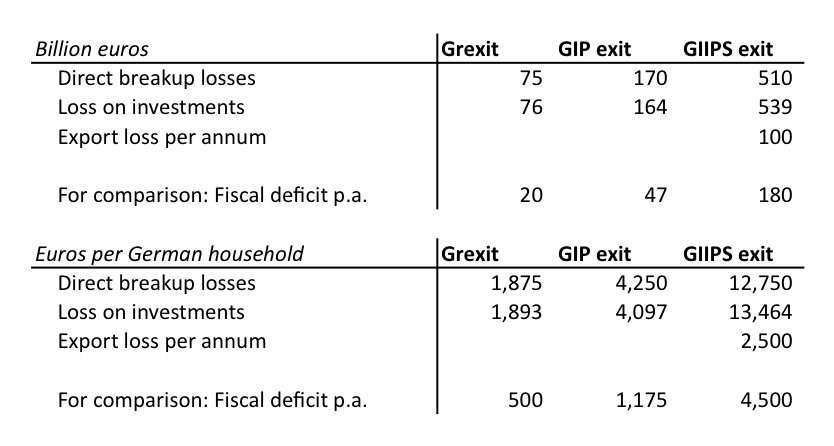
But the current sentiment is overshadowed by tendencies of disintegration. The economic Diktat has stoked popular resentment in the crisis countries, toppling the political leadership and sometimes leaving the necessary political reforms in limbo. This is pretty bad. Unless there are second thoughts on both sides, the alternative is the disintegration of the euro area. While Greece may be the first and obvious candidate to exit, it is hard to imagine how to contain further disintegration. Preventing contagion that will trigger the exit of others (described here) will only be contained through large and unconditional commitments from Germany. These commitments may dwarf the cost of keeping Greece in the euro area in the first place. Let's run some numbers. Below table composes direct breakup costs, losses from German investments in the crisis countries, and the drag on annual export demand. 


The direct breakup losses to Germany from the default of exiting countries on official debts, assistance, and ECB claims are estimated at around EUR75 billion (EUR1,875 per German household). This number would increase to around EUR170 billion (EUR4,100 per German household) if Ireland and Portugal are included, and more than triple if Italy and Spain were added.

The new currencies in the exit countries are likely to depreciate vis-a-vis global currencies, resembling previous currency crises that very often bankrupt the corporate sector given the extent of their foreign liabilities. This would pose a risk for banks and other investors in Germany (and elsewhere) which have significant exposure to those countries. Given the slim capital buffer in banks nowadays, their recapitalization is likely to fall again into taxpayers' laps. Assuming the depreciation in the exit countries and their economic collapse causes losses on German investments of 50 percent in Greece and Portugal, and 25 percent in Italy and Spain, the potential damage on Germany's wealth would amount to EUR0.5 trillion (EUR13,000 per household).

These first two types of losses are a one-time hit, maybe still considered worth the bang compared to annual transfers of about EUR47 billion (EUR1,175 per German household) to plug the fiscal deficits of Greece, Ireland, and Portugal. Adding Spain and Italy would of course increases the annual bill significantly to EUR180 billion (EUR4,500 per German household), all assuming that deficits don't slim down.

In addition to the one-time hit, lower exports may at least temporarily put a drag on Germany's Wirtschaftswunder. Export demand from Greece, Italy and Spain---making up about 10 percent of German exports---would collapse, although there may be some offsetting effects. The appreciation of the neue deutsche Mark would reduce demand for German exports from other countries. In combination, there could be an annual loss in export demand of some EUR100 billion (EUR2,500 per household). 

The crisis is like a good party for Germany, but the next morning will arrive soon. While stakes are high, the situation is not lost. According to a recent survey, the majority of European economists continue to think that fiscal integration is needed to save the euro area. The dominating opinion in Germany is more sceptical. Let's just be aware how costly it is to pull the plug!

Monday, November 7, 2011

Economics 1-ohhh-1: Reform, not exit, is the right medicine

An often publicly heard policy recommendation is that weaker euro zone members should right themselves through austerity or leave the currency union. In any case, reform---not exit---is the right medicine. 

The adjustment program implemented in Greece, Portugal, and Ireland are trying to strike a difficult balance between the necessary and the possible to turn around the economies. Orderly adjustment needs time and solidarity, just as it needed more than a decade and two trillion euros for former East Germany to get close to Western Germany's levels. German reunification like Europe's integration is, then and now, a political challenge and a historical chance. All the economic discipline can contribute is pointing out pitfalls and making good proposals to maximize welfare. The rest hinges on hearts and souls in Europe.

In my previous post, I discussed ways to tackle the debt problem through growth, inflation, transfers or default. In conclusion, I warned about the hidden costs and distributional effects when politicians fish for solutions that are popular with the electorate. In what follows, I argue that the same applies to an exit from the currency union.

Imagine again three countries that form a currency union: A large and strong country, called Oak, whose currency enjoys high credibility. The credibility has lead to internal exchange rate stability (another word for low inflation) as well as external exchange rate stability (another word for a strong currency). Then there is small Olive with a weak currency and inflation, and a large Pepperoni with a likewise weak currency and inflation. These three join into a currency union at reasonably competitive exchange rates, largely adopting Oak's stern monetary policy. What's next?

Only if the currency union is a credible construct will the benefits materialize. Only then will interest rates drop to Oak's level, as does inflation. Why is that? Olive and Pepperoni inhabitants start to believe that the central bank in the currency union is now guarded by oaky officials destined to fight inflation. Instead of expecting an endless spiral of higher prices and a depreciating exchange rates, internal and external price stability become engrained in the people's expectations. No longer do they need to ask for high interest rates on their savings to protect their savings against inflation, no longer do they need to flee their country and deposit their financial savings in Oak. No longer are interest rates high on investment loans. In response to the currency union, capital inflows and investment pick up, in turn creating demand for Oak's exports. This is what happened after the creation of the euro zone to the mutual benefit of all member countries.

If the currency union is not a credible construct, these benefits will not materialize. There is no point in having a currency union (or other fixed exchange rate regime) that is not believed to be lasting. Imagine Olive is being hit by a shock, whether it is self-inflicted (laziness to maintain the orchards until the olive trees are beyond recovery) or not (discovery of better tasting olives in another country). After the shock, the country would suffer from lower demand for their output (dead trees in orchards don't yield a harvest or traditional olives rot on the shelves while imported better tasting ones sell like, well, hotcakes). Banks across the currency union with loans to Olive would suffer losses because farmers are unable to repay their loans. If in this situation, the credibility of the currency union is called into question, the situation would get worse: Olive farmers would shift their savings out of the country, the banks in Olive would become illiquid, and there would be no credit for those farmers who are willing to invest in orchards. (Tendering their existing trees, or planting those with the better taste.)

This is why the integrity of the currency union is crucial. Even worse, the confidence effects are not limited to Olive. Once inhabitants of Pepperoni notice that Olive's exit from the currency union is considered, they would also empty their bank accounts given Pepperoni is known to be a weaker economy than Oak. Pepperoni's inhabitants would anticipate their exit from the currency union in expectation that every country is eventually hit by a shock. With Pepperoni being larger, the currency union would unravel in its entirety. The benefits of the currency union would get lost whether or not the currency union is formally ended or not.

Is it possible to operate a currency union in which there is not full trust? Many countries continue to do so, yet, mostly against the advice of economists. Heavy-handed regulations and ensuing distortions can maintain an exchange rate regime that lacks credibility. However, this usually leads to repeated crises and deadweight losses. Measuring these economic losses is often impossible. Thus, it is probably possible to manufacture an exit of Olive (while preserving the membership of Pepperoni) while curtailing the visible costs through regulations and the like. But, once again, the costs will be high yet hidden. Hence, let's not get fooled that exit is a costless solution, neither to Oak nor to Olive. Those who call for the disintegration of the euro zone should be aware of the political and economic damage they are inflicting on all.

Finally, a note on the benefit of devaluation to Olive upon exiting the currency union. Besides the direct costs to Olive (currency losses of savers, rescue of the banking system, etc.), the question is whether the devaluation does the trick. Given the economic and social pain of an internal devaluation (i.e., lowering domestic prices and wages), the external valuation (i.e., currency devaluation) is indeed an instant pain relief. That is why most countries enjoy high growth rates after a devaluation. Yet, many of them suffered repeated crises with repeated devaluations, and all the unpleasant things that happen during crises. Why does pain relief not do the trick? Because the pain relief treats a symptom, not the cause. The cause are usually inflexible labor markets, inefficiently large public sectors, lack of contract and law enforcement, limited competition, and the like. These must be addressed by reforms.

Structural reform is the right medicine for Olive. Exiting the currency union is not.